Return to year 1890
Chinatown in Yokohama
Sacramento Daily Union, Volume 79, Number 29, 27 March 1890
Suspicions about Japanese girls on the City of Peking
March 30, 1890 San Francisco Chronicle
Immoral Japanese
Two girls who will be sent home.
The legality of the course pursued by Collector Phelps against Asiatic women.
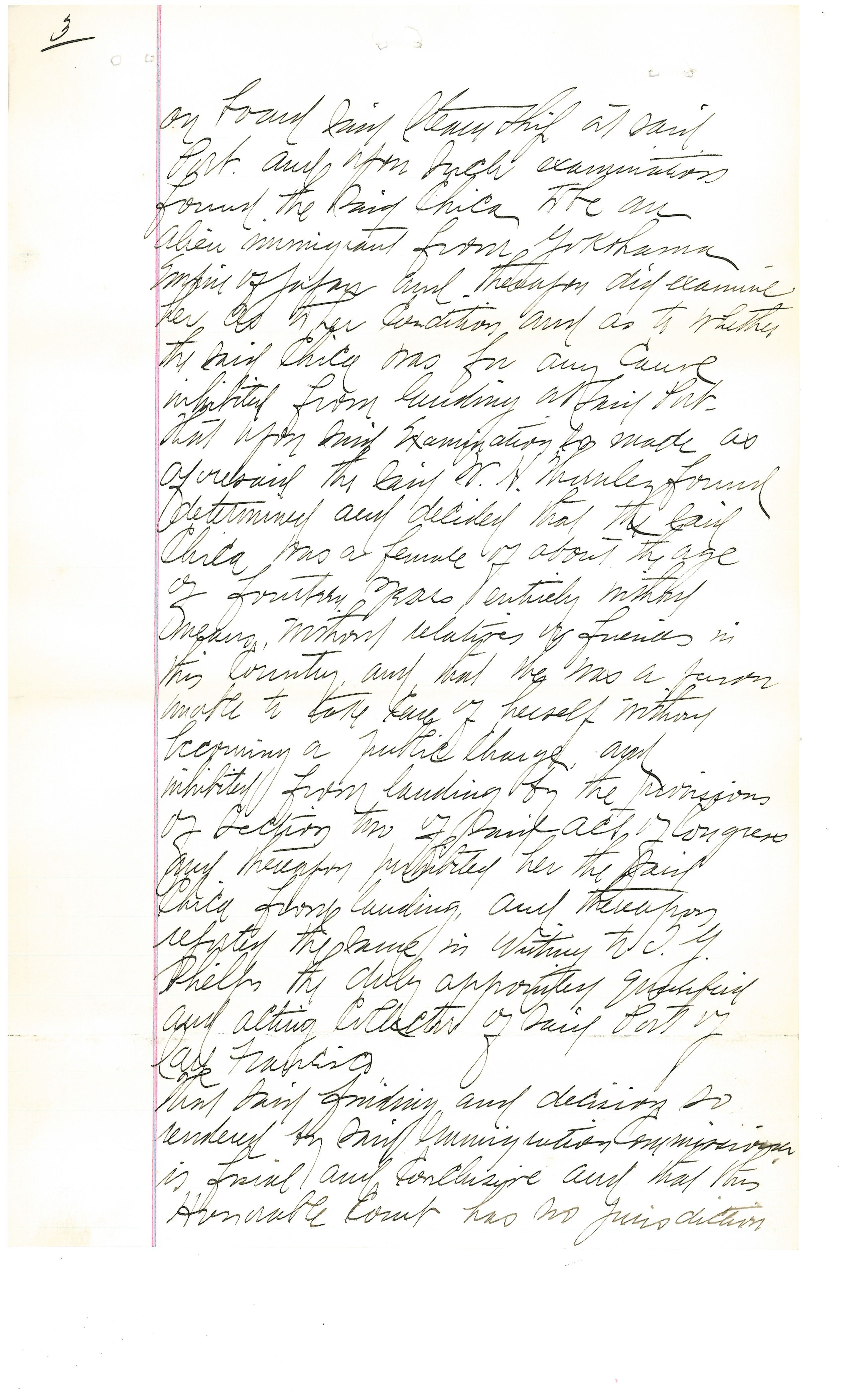
Commissioner of Immigration William H. Thornley has concluded his examination of the two Japanese girls who arrived here on the City of Peking, and finds that they are utterly without means, friends or relatives in this country. The Japanese to whom they referred the Custom officers is a notorious keeper of brothels in this city. Under the circumstances the Commissioner has recommended Collectors Phelps to refuse the women a landing, and the Collector has ordered them to be sent back on the first returning steamer. The two girls are named Chika Shenonen, 16 years of age, and Torni Kauakichi, aged 17 years. In his endeavors to remand Japanese women of this class Collector Phelps is receiving the active co-operation of the Japanese Consul and of the Japanese Mission in this city.
Considerable has been said by interested lawyers and others respecting the right of the Collector of the port to remand Chinese or Japanese women of the class against whom Collector Phelps has been directing his energies. The fact that the Collector has been successful in remanding women already landed and the knowledge by Chinese slave-dealers that having once passed the ordeal of the courts their victims may still be sent home at any time have occasioned emphatic assertions that the Collector is exceeding the rights granted by the immigration act of 1882
Under the Congressional law entitled "An act to regulate immigration," which was adopted by Congress on August 3, 1882, the Secretary of the Treasury is charged with the execution of the acts and may enter into contracts with the State commissioners for that purpose. The commissioner shall examine into all races necessitating his attention and report his conclusions to the Collector, who has power to act. Those who shall be refused admission are "convicts, lunatics, idiots or any person unable to take care of himself or herself without becoming a public charge." Upon the implied powers of these provisions and the evident character of the livelihood to be earned by the women in this country, the Collector bases his efforts against admitting Chinese and Japanese prostitutes.
Daily Alta California, Volume 82, Number 91, 1 April 1890
Investigation of Japanese girls
April 2, 1890 San Francisco Chronicle
Japanese girls
They ask to reside in this country.
Circumstances which bear out a suspicion that they are brought with a purpose.
Writs of habeas corpus for the Japanese girls, Chica and Shimaza Toche, who arrived here on the City of Peking, were applied for yesterday in the United States District Court, and the girls were released on bonds of $1,000 each until their petition shall be heard on Friday at 2 o'clock.
Upon the recommendation of Commissioner of Immigration W. Thornley, Collector Phelps had decided to send the women home as they had no money nor friends, and could refer the customs officers only to a countryman named Kanagaugua, a notorious keeper of several houses of ill fame in this city.
The writ was issued yesterday morning, and quite a different story was told by the young women of the purposes for which they are intended in this city. Chancellor Fujitu and Mr. Richardson of the Japanese Consulate have been in active co-operation with Collector Phelps in his endeavors to exclude disreputable women, and were present yesterday when the bail bond for the girls was sworn to by local Japanese. G. Hasekawa, a Japanese tradesman at 1023 Market street, one of the bondsmen, declared that he had sent for the girls, who are unusually comely, to work in his establishment, and that the similarity between the name of his notorious countryman and his own had led to an unfortunate confusion and unjust suspicion against the girls whom he intended: to engage in the making of crystal jewelry. The girls were closely questioned respecting the character of their prospective occupation, but could give no intelligible answer, and the representatives of the Japanese Consulate were compelled to rest content with the reply that they were here to work. The girls, pretty of feature and oddly costumed, presented a pleasing contrast to the usual Chinese petitioners, who bear lead in this.
San Francisco Call, Volume 67, Number 147, 16 April 1890
Judge Hoffman took case under advisement.
Petition to dismiss was introduced. I do not know the final outcome of this case.




Index to Habeas Corpus Cases for the US District Court for the Northern District of California, San Francisco