civics and economics
Democratic Capitalism: Motivations and Influences
Anthony Oertel, tony@frederickbee.com
Democratic capitalism requires citizens to fulfill four roles: voter, taxpayer,
worker, and consumer. (Image 1).
The roles of a democratic capitalist balance each other.
A voter balances his desire for government services against an affordable tax burden.
Workers consume an amount equal to or less than their wages.
Influence is the capacity to have an effect on the character, development, or behavior of someone or something, or the effect itself.
Motivation is to stimulate interest in or enthusiasm for doing something.
Democratic capitalists must understand these persuasive techniques to function within society's framework.
Factors that affect participation: age, gender, education, language, disability, disenfranchisement
Motivations and influences
Types of voters, taxpayers, workers, and consumers
Media and markets
References
Image number 1 - voters, taxpayers, workers, consumers
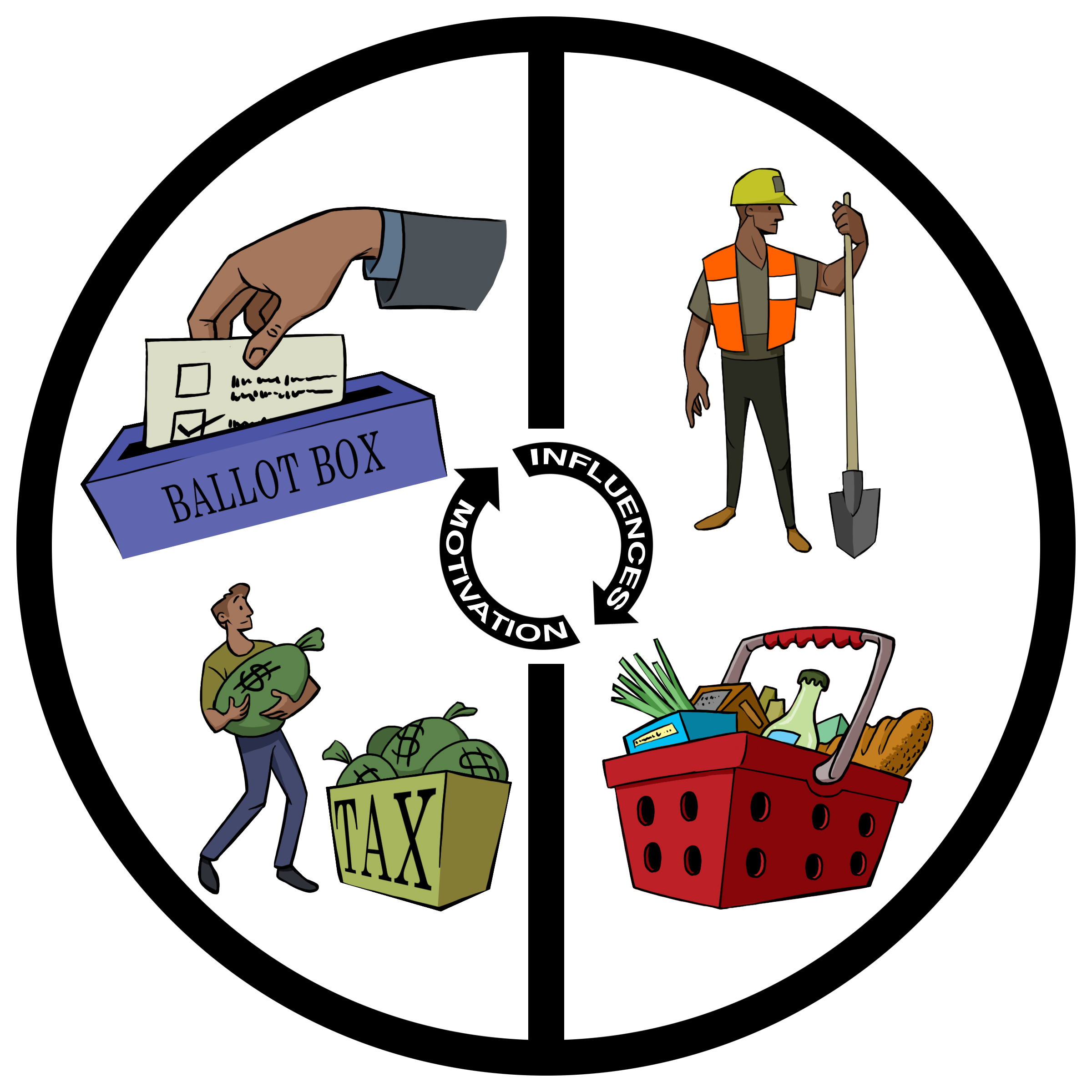
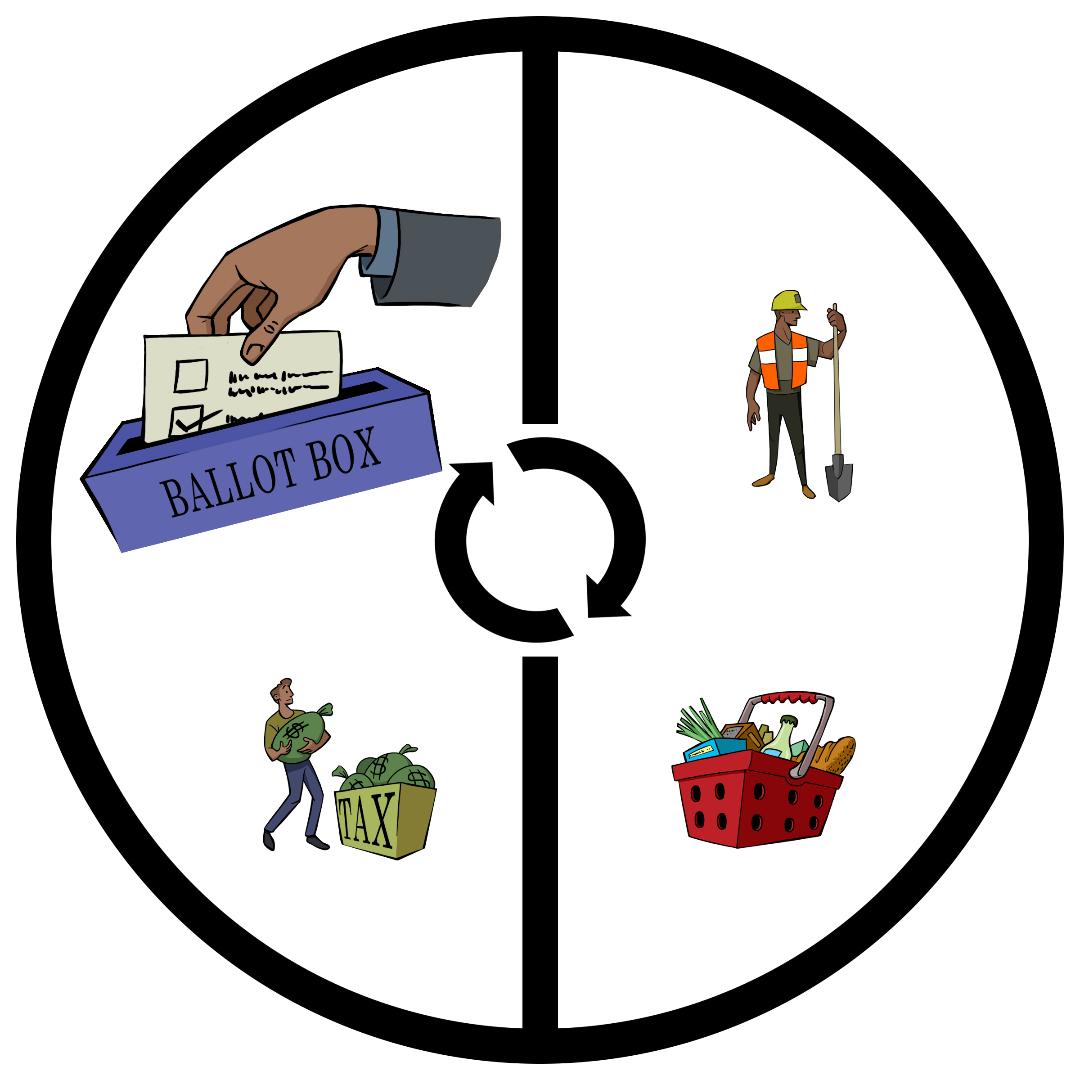
Image number 2 - full-time worker who becomes part-time
Motivations and influences
Voters
1. Political rhetoric that provokes fear - emphasizing the risks of terrorism, economic instability and so on - can have a subtle but powerful effect on some groups of people when it is used to try and sway votes.
2. 'Negativity bias' is a well-documented tendency of people to preferentially remember negative information, allows negative emotions to dominate decision-making. (1)
3. Voter background means the voter's social identity, such as economic class, ethnicity, gender, race and religious preference.
4. Party identification means not just a voter's party affiliation but also a voter's psychological attachment to a particular political party.
5. Incumbent status can influence a voter's decision. A voter's view of an incumbent's previous performance greatly influences that voter's decision. (2)
Taxpayers
1.Type of tax - Visible taxes on income, property, capital gains paid as a lump sum.
Versus
Less visible taxes closely identified with a specific benefit and paid in small increments throughout the year.
2. Sequence - Implementing a tax prior to a vote on its retention gives voters direct, personal information.
3.Information - Technical information (climate change) versus moral appeals (an appeal in an advertisement or sales literature that is directed to the audience's sense of what is right and proper.)
4.Doubt - Fear of the unknown (carbon tax)
5. Types of supporters - organized constituencies that promote tax reform
6. Method - amendment to State Constitution, change to tax code, ballot proposition (3)
Workers
1.Compensation - Pay provided by an employer to its employees for services rendered (i.e., time, effort, and skill). This includes both fixed and variable pay tied to performance levels.
2. Benefits - Programs an employer uses to supplement the cash compensation employees receive. These health, income protection, savings, and retirement programs provide security for employees and their families.
3. Work-life effectiveness - A specific set of organizational practices, policies, and programs, plus a philosophy that actively supports efforts to help employees achieve success at both work and home.
4. Recognition -Formal or informal programs that acknowledge or give special attention to employee actions, efforts, behavior, or performance and support business strategy by reinforcing behaviors (e.g., extraordinary accomplishments) that contribute to organizational success.
5. Performance management - The alignment of organizational, team, and individual efforts toward the achievement of business goals and organizational success. Performance management includes establishing expectations, skill demonstration, assessment, feedback, and continuous improvement.
6. Talent development - Provides the opportunity and tools for employees to advance their skills and competencies in both their short- and long-term careers.(4)
Consumers
1. Reciprocity - Humans often feel the need to return a favor or reciprocate kind gestures. For consumers, this might mean offering a free sample or a generous discount, for example.
2. Commitment - Once someone is engaged with something, they are more likely to stick with it. In business, this means cultivating brand loyalty; once someone is working with a product or using a service, they are more likely to commit to paying for it again.
3.Pack mentality - If more people do something, others are likely to do it as well. When brands can demonstrate their popularity or satisfaction across a wide customer base, other consumers are more likely to buy in as well.
4.Authority - People are more likely to listen to an expert than anyone off the street. So, while pack mentality is important, having a relevant expert speak to the effectiveness of a brand's product or service is essential to converting new consumers.
5.Liking - People who are similar to the target consumer are more likely to persuade the consumer to buy. People from similar demographics - whether in terms of ethnicity, socioeconomic class, religious inclination or even shared interests - are far more effective at persuading consumers than those they perceive as vastly different.
6.Scarcity - People tend to want what they perceive they cannot have. Making a product or service seem exclusive or as if it will go out of stock if they don't act quickly often makes it more enticing to the consumer and increases the likelihood that they will buy in. (5)
Top of page
Types of voters, taxpayers, workers, consumers
Voters
1. Issue voters base their decisions on how the candidates address political issues.
2. Party voters cast their vote based on their self-identification with a particular political party. (6)
Taxpayers
Types of taxpayers: individual, business, labor, retirees
Workers
1. Employees: full-time, part-time, casual, fixed term, shift workers, daily or weekly hire, probation, apprentices and trainees, outworkers. (7)
2. Self-employed persons may be involved in a variety of occupations but generally are highly skilled at a particular kind of work. Writers, tradespeople, freelancers, traders/investors, lawyers, salespeople, and insurance agents all may be self-employed persons.(8)
Consumers
1. Loyal Consumers: Loyal consumers are likely to comprise a small segment of your consumer base. However, because of their loyalty, they are valuable to every business. Once they have found the right company to do business with they will remain loyal, often becoming a promoter of the brand by sharing their experience with their friends, family and extended social network. According to a recent study, only between 12 percent and 15 percent of consumers are loyal to a single retailer. However, that small group tends to generate between 55 percent and 70 percent of brand sales. How can a brand successfully market to a loyal consumer? The keys are personalisation, individualised attention, and repeated marketing contact. These kinds of marketing strategies will yield the biggest return on investment.
2. Discount Consumers: Discount consumers are always on the hunt for discounts, as the name suggests. Like loyal consumers, they also have a tendency to frequent the same organisations and brands. However, they only make purchases when there is some kind of sale or discount. To market to the discount consumer, you need to advertise your offers and specials! Social media is a great way to share sales and ongoing promotions, as are personalised emails or brochures. If you have a sale going on, you need to let your customers know.
3. Impulsive Consumers: Impulse consumers are the most difficult when it comes to maximizing marketing collateral. These consumers often don’t shop with a specific product or service in mind, let alone a brand. Rather they make purchases capriciously, buying when something strikes their fancy. Considering the whimsical nature of impulsive consumer purchasing habits, tailoring marketing efforts to them may not seem to be the best use of your resources, right? Wrong. The vast majority of purchases are actually impulse purchases.
When brands figure out how to effectively market to impulse consumers, they can drive up their sales. Keep in mind that impulse buying tends to be emotionally driven as opposed to logically driven. This is distinct from more rationally driven consumer types, such as discount consumers (driven by a desire to save money) and loyal consumers (driven by fealty to a specific brand). The key is to tap into the impulsive consumer’s emotions.
4. Need-Based Consumers: Need-based consumers purchase to fulfill a need. Maybe they have run into financial trouble and need advice. Perhaps they are going on vacation and need a new set of luggage. They could be approaching a milestone in their life and are seeking legal advice. In order to market to a need-based consumer, your marketing strategy needs to anticipate these needs effectively. That means utility-centric marketing, across multiple channels, including print, online, and social media. You need to segment your consumers by needs and tailor a marketing strategy to each of these needs, outlining how you can help in a particular situation or promoting a specific service.(9)
Top of page
Media and markets
Media
Voting is voluntary. Pay taxes is mandatory.
A taxpayer balances his desire for government programs against his household budget in the free marketplace of ideas. Can the taxpayer afford the government programs he wants? What media are used to persuade the taxpayer?
1. Traditional radio and digital equivalents such as podcasts
2. Video and film based content such as television, movies, promotional videos, commercials and video-sharing websites.
3. Publications such as books, magazines, newspapers, blogs and research papers
4. Social Media are digital tools that allow people to communicate and share and produce content.
5. Traditional mail and digital messaging tools such as email and messaging
6. Digital Communities are forums, chats and other tools that allow people to socialize, share information and form communities.
7. Digital games and virtual environments
8. Applications is a general term for software that people use including mobile.
9. Graphics such as signs, billboards, digital advertising, t-shirts and product packaging.
10.Public Speaking is speaking directly to groups of people often with visual aids such as graphics, slides and video.
11. Art and music displayed in public and musical performances.
12. Theater and other performances such as dance(10)
Markets
Working and consuming are voluntary.
A worker balances his wages against his consumption in a free market. Can the worker find a job that pays a wage to meet the cost of his consumption?
1. Labor market, also known as the job market, refers to the supply of and demand for labor, in which employees provide the supply and employers provide the demand. It is a major component of any economy and is intricately linked to markets for capital, goods, and services.(11)
2. Free markets is an economic system based on supply and demand with little or no government control. It is a summary description of all voluntary exchanges that take place in a given economic environment. Free markets are characterized by a spontaneous and decentralized order of arrangements through which individuals make economic decisions. Based on its political and legal rules, a country's free market economy may range between very large or entirely black market.(12)
Top of page
References
1. The hidden psychology of voting
2. Factors that Influence Voters During Presidential Elections
3. Saying Yes to Taxes: The Politics of Tax Reform Campaigns in Three Northwestern States, 1965–1973 by Elizabeth Pearson
American Journal of Sociology
Vol. 119, No. 5 (March 2014), pp. 1279-1323 (45 pages)
4. Influencing Employee Performance and Motivation
from
OpenStax, Principles of Management. OpenStax CNX. Jun. 21, 2019
5. The Science of Persuasion: How to Influence Consumer Choice
6. How Voters Decide
7. Types of employees
8. Guide to successful self-employment
9. Different Types of Consumers & How to Market to Them
10. Twelve types of media
11. Labor Market
12. Free Market
Top of page